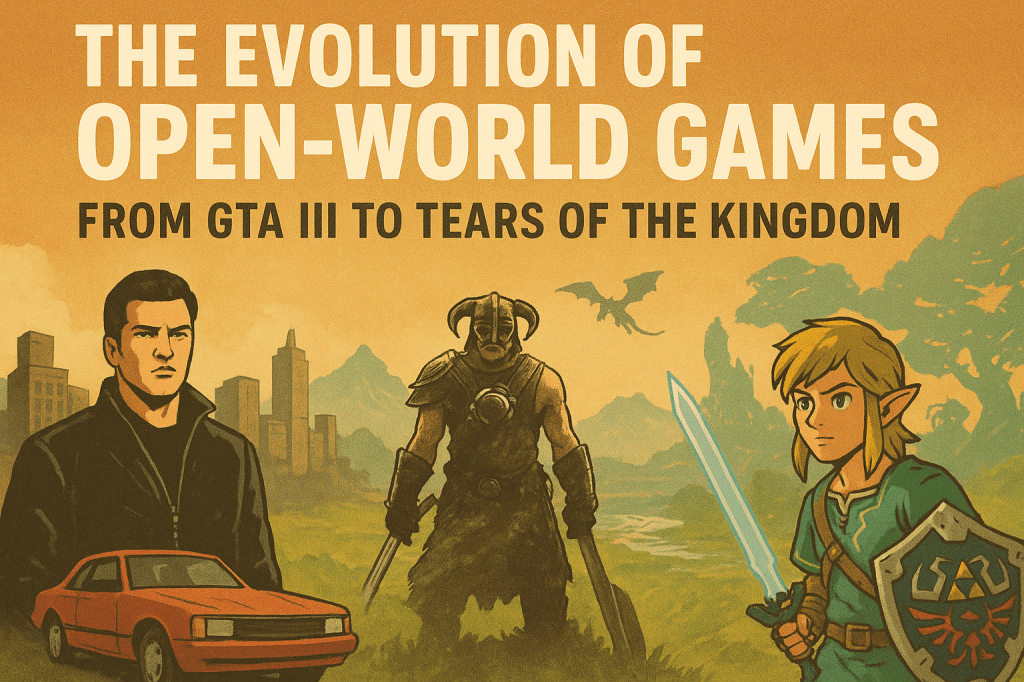
Open-world games have transformed from ambitious technical experiments into some of the most beloved and commercially successful experiences in gaming. Over the past two decades, we’ve seen the genre grow in complexity, scope, and ambition—pushing the limits of storytelling, world-building, and gameplay. Let’s take a deep dive into the titles that defined this evolution, beginning with Grand Theft Auto III and ending with the genre’s modern marvels like The Legend of Zelda: Tears of the Kingdom.
The Turning Point – Grand Theft Auto III (2001)
Before GTA III, “open-world” games existed but were relatively limited in scope and immersion. Rockstar Games changed the landscape with a fully 3D, living city—Liberty City—where players could roam freely, take on missions in any order, or simply cause chaos.
Innovations:
- True 3D, seamless city exploration.
- A mix of nonlinear storytelling with emergent gameplay.
- A persistent, dynamic world that responded to player actions.
GTA III wasn’t just a game—it was a sandbox of possibilities, and it set the foundation for the next two decades.
Refinement & Expansion – The Mid-2000s
The years after GTA III saw developers experimenting with size, interactivity, and narrative depth.
Key Titles:
- The Elder Scrolls III: Morrowind (2002) — A vast, handcrafted fantasy world with deep role-playing systems.
- Far Cry (2004) — Brought open-ended combat to lush, tropical environments.
- Assassin’s Creed (2007) — Introduced parkour-style traversal and historical settings, blending open worlds with cinematic storytelling.
Innovations:
- More immersive worlds with unique biomes and cultures.
- Better integration of story and player freedom.
- Increased use of verticality and exploration as core gameplay.
Cinematic Storytelling & Player Agency – Red Dead Redemption & Skyrim Era
By the early 2010s, open-world games were no longer just about size—they were about creating believable worlds that felt alive.
Key Titles:
- Red Dead Redemption (2010) — Delivered a Western frontier filled with memorable characters, moral choices, and environmental storytelling.
- The Elder Scrolls V: Skyrim (2011) — Offered a massive world packed with lore, side quests, and the freedom to shape your own destiny.
- The Witcher 3: Wild Hunt (2015) — Raised the bar for narrative-driven open-world design, blending deep storytelling with meaningful side content.
Innovations:
- Branching narratives and moral decision-making.
- Rich environmental details that told stories without dialogue.
- Fully voiced, high-quality side quests that rivaled main stories.
Emergent Gameplay & Systems-Driven Worlds – Breath of the Wild (2017)
Nintendo’s The Legend of Zelda: Breath of the Wild redefined open-world design by focusing on player experimentation and systems-based gameplay.
Innovations:
- Physics-driven mechanics allowing endless solutions to problems.
- Climbing and gliding that gave players true freedom of movement.
- Minimal hand-holding, encouraging organic discovery.
This approach shifted the genre from simply giving players a big world to play in toward letting players play with the world itself.
The Present – Tears of the Kingdom & Beyond
The Legend of Zelda: Tears of the Kingdom (2023) built on its predecessor’s innovations by adding deep crafting systems, multiple layers of vertical exploration, and even more freedom to interact with the world.
Current Trends:
- Player-driven creativity as a core mechanic (vehicle building, environmental manipulation).
- Persistent, reactive worlds with evolving ecosystems.
- Hybrid genres—open-world elements blending with survival, RPG, or simulation mechanics.
Looking Ahead
The journey from GTA III to Tears of the Kingdom shows that open-world games are no longer about who can make the biggest map—they’re about who can create the most meaningful one. The next frontier will likely push AI-driven NPCs, more dynamic storytelling, and worlds that change in real time based on player influence.
From the streets of Liberty City to the skies of Hyrule, open-world games have come a long way—and they’re only just beginning to show what’s possible.
 Jimmy's Deals